Measurement
Facility
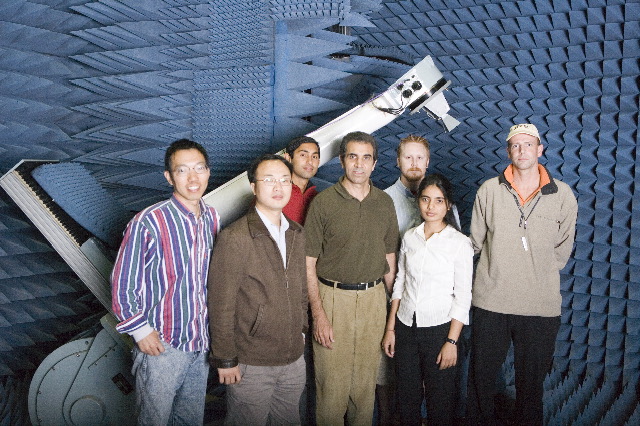
The state-of-the-art Antenna Research
Laboratory (ARL) of Villanova University, with its indoor facility that
includes a 29’ x 27’ x 28’ anechoic chamber (compact range), is capable
of fully automated high quality pattern and gain measurements from
2 to 40 GHz. It is equipped with:
- ORBIT / FR Compact Range Serrated Reflector (AL-22404-AL) with 5’
X 5’ quite zone with a operational frequency range of 1-100 GHz
- HP8510C Network Analyzer and Data Acquisition System
- HP 85301C Antenna Measurement System: HP 8530A microwave
receiver, 8511B frequency converter and HP 83631B source (0.045-50GHz)
- Orbit/FR 959S3 Antenna Measurement and RCS System Workstations
- Orbit/FR AL-0360-IP Polarization Positioner
- Orbit/FR AL-4273-1 Elevation over Azimuth Positioner
- Orbit/FR 4806 Controller 6 axis
The ARL is also linked to the microwave laboratory in the ECE
department, which is well equipped for impedance and S-parameter
measurements.
Plans are underway to
extend the frequency range of the compact range to 75GHz over the next
12 months. In addition Villanova has teamed with Naval Sea Systems
Command, NAVSEA-Philadelphia, to extend the capabilities of ARL to
include accurate radar cross-section (RCS) measurements. This
Academia/Government relationship allows Villanova’s ARL to offer
extensive facilities and expertise to Government and Industry for the
development, integration, evaluation and testing of RCS and antenna
components and systems.
Computational
Facility
Computer facilities available for
research in the antenna research laboratory include a network of
several UNIX and Xenon workstations including one 8-processor server
with 32 GB of RAM and four 4-processor units with memory ranging from
with 4 to 8 GB. In addition, this
laboratory is networked through a T3 line to the ECE department’s
network of more than 60 Sun research workstations as well as to
the college of engineering network of about 150 XP
workstations. The access to this vast network of workstations could
allow the parallelization of the electromagnetic computational
algorithms for fast optimization of antenna and microwave structures.
The available computational software packages in the antenna laboratory
include various commercial electromagnetic simulators and antenna CAD
tools as well as numerical codes developed in-house at the ARL. In
particular, the electromagnetic simulation codes available for research
include:
- XFDTDTM, for finite-difference time-domain (FDTD)
modeling of arbitrary 3-D structures,
- EnsembleTM for method of moments (MoM) modeling of
planar microstrip radiating structures,
- IE3DTM for method of moments (MoM) modeling of 3-D
microstrip circuits and antennas,
- CST Microwave Studio for time- and frequency-domain modeling of
3-D electromagnetic structures,
- MomentumTM for method of moments modeling of planar
microstrip structures,
- SonnetTM for method of moments (MoM) modeling of 3-D
planar circuits,
- High Frequency Structure Simulator (HFSSTM) for finite
element method (FEM) modeling of arbitrary 3-D structures,
- FEKOTM for hybrid FEM-MoM or UTD-MoM modeling of large
3-D antenna/microwave structures,
- Numerical Electromagnetic Code (NEC)
for simulation of wire-mesh modeling of conducting structures.
- Various FDTD and MO M
based simulation and
design optimization codes developed in-house at the Antenna Research
Laboratory at Villanova.
Post-Doctoral
Fellows (2005-2006)
- Dr. Gang Liu
- Dr. Afef Slama
Graduate Students (2005-2006)
- Hui Huang
- Harish Koduri
- Varada Rajan Komanduri
- Shamsha Lakhani
- John McVay
- Nick Pizzo
- Chris Thajudeen
Affiliated
Antenna Engineers
- Bill Ailes (Wyle Labs/General Dynamics)
- Frank Plonski (NAVSEA)
- Paul Rush (NAVSEA)
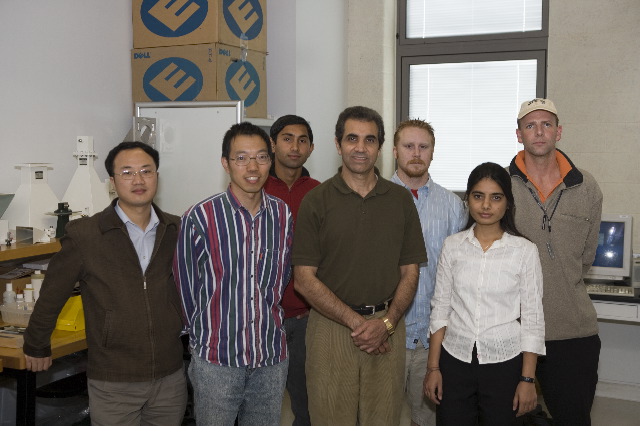
Some members of ARL Research Team in
Fall 2005